• PM, US & Iran presidents sign ‘Islamabad MoU’ • Traffic flows through Hormuz as accord takes effect
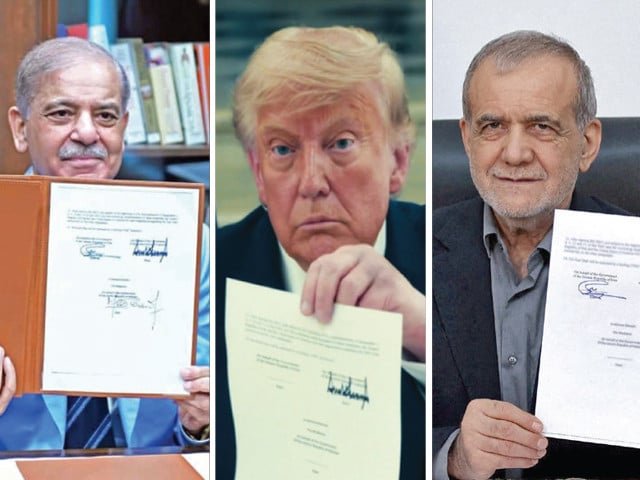
Prime Minister Shehbaz Sharif on Thursday signed the historic ‘Islamabad Memorandum of Understanding’ (MoU) as a mediator, formalising a major diplomatic breakthrough between the United States of America. the Islamic Republic of Iran.
US President Donald J Trump signed the document while visiting French President Emmanuel Macron at the Palace of Versailles.
Concurrently, Iranian President Masoud Pezeshkian signed the accord in Tehran, with the Iranian state news agency, IRNA, releasing images of the president signing. displaying the document, which already featured President Trump’s signature.
The Iranian president welcomed what he called a “historic” deal with the United States to end their war. pave the way for negotiations towards a final settlement.
“This is a historic document. a message from a powerful Iran: peace will be achieved in the shadow of mutual respect,” Pezeshkian said, in a social media post showing an image of the document, which carried his signature as well as US President Donald Trump and their mediator, Pakistani Prime Minister Shehbaz Sharif.
Later, Prime Minister’s Office released images of Prime Minister Shehbaz Sharif inking the MoU as the mediator. The images showed the prime minister displaying the finalized document bearing the signatures of both the US and Iranian presidents.
“I am honoured to announce that the historic ‘Islamabad Memorandum of Understanding’ has been electronically signed today between the United States of America. the Islamic
war,Republic of Iran. The Memorandum has been signed by honourable Presidents of both the countries. also endorsed by me as the mediator,” the prime minister earlier announced on his X timeline.
The prime minister said that the Islamabad MoU would enter into force with immediate effect. as a first step, Iran would instantly reopen the Strait of Hormuz and the United States (US) would immediately lift the naval blockade.
The prime minister offered heartfelt congratulations to US President Donald J Trump for his commitment to diplomacy,. expressed profound appreciation to Supreme Leader of Iran, Ayatollah Seyyed Mojtaba Hosseini Khamenei, and Iranian President Masoud Pezeshkian for their wisdom and statesmanship.
He also commended the key contributions of the respective negotiating teams, regional partners including Qatar, Saudi Arabia, Türkiye,. Egypt, as well as Chief of Defence Forces Field Marshal Syed Asim Munir for his instrumental role in advancing regional stability.
President Trump had signed the MoU while visiting French President Emmanuel Macron at Versailles. President Pezeshkian signed the document while being in Iran as the Iranian news agency IRNA issued the images of him signing. displaying the document which featured Trump’s signature.
Prime Minister Shehbaz Sharif on Thursday received a telephone call from Iranian President Dr Masoud Pezeshkian. marking their first contact since the signing of the historic Islamabad Peace Deal.
The conversation lasted over 30 minutes. focused on regional peace, bilateral relations, and future cooperation between the two neighbouring countries, according to a press release issued by the PM Office.
The prime minister congratulated President Pezeshkian, the Iranian leadership. the brotherly people of Iran, on the signing of the historic peace deal.
This landmark deal, he said, would not only help restore peace in the region, but also go a long way in rebuilding the Iranian nation. further strengthening Pakistan-Iran ties, across all areas of mutual interest.
He also conveyed his respectful regards to Ayatollah Sayyid Mojtaba Hosseini Khamenei, the Supreme Leader of Iran.
While lauding Iran’s decision to sign the peace deal, the prime minister wished the Iranian side success in the next phase of negotiations. assured the Iranian President of Pakistan’s continued support to Iran, both as a brotherly and neighboring country, in all spheres.
On behalf of the Iranian nation as well as on his own behalf, President Pezeshkian thanked the Prime Minister. the Field Marshal Syed Asim Munir, for their extremely critical roles in steering the mediation process, with great skill and sincerity, that had ensured its success.
He said that Iran would always remember Pakistan’s positive. constructive efforts and its support for Iran during these difficult times.
While conveying his best wishes for the people of Pakistan, the Iranian President said that Iran was keen to enhance. expand its bilateral ties with Pakistan across all areas of mutual interest.
Both leaders agreed to visit each other’s capitals at the earliest possible opportunity to carry forward the excellent cooperation between the two sides in bilateral as well as regional matters.
They also agreed to remain in touch in the coming days.
Meanwhile, oil tankers sailed through the Strait of Hormuz. the United States said it lifted its blockade on Iran on Thursday as an interim deal to end the war took effect, though key issues are still unresolved between the two countries.
Oil prices dropped to their lowest level since the war began on February 28. as analysts said exports through the strait, which handles about one-fifth of global oil supply, could return to normal in the coming months.
In Washington. some of President Donald Trump’s Republican allies in Congress questioned whether he had given up too much in order to end the conflict, which is unpopular with U.S. voters.
Iran’s Supreme Leader Ayatollah Mojtaba Khamenei said Trump signed the deal “out of desperation”. signaled that upcoming talks over Iran’s nuclear program - Trump’s stated reason for starting the war - would not be easy.
“If the American side wants to be too demanding, we will not accept it,” he said in a written message.
The deal gives negotiators 60 days to reach agreement on the status of Iran’s nuclear program,. set up a $300 billion reconstruction fund for Iran and other financial incentives. US Vice President JD Vance. who will lead the US delegation, said Washington will also seek to limit Tehran’s long-range missiles.
When he launched the war nearly four months ago, Trump said he aimed to destroy Iran’s nuclear weapons program, end its ability to strike its neighbours, prevent it from supporting allied militants in the region. make it possible for Iranians to topple their hardline leaders.
Though he initially demanded Iran’s “unconditional surrender,” Trump ultimately signed the agreement with none of those objectives met.
US officials say the negotiations could still yield a strong agreement on Iran’s nuclear program. But critics say Iran is in a stronger position now, having withstood a superpower attack, exerted control of the Strait of Hormuz. gained valuable waivers to financial sanctions.
Iran signaled it will still exert control over the strait, saying it will issue permits. direct traffic during the 60-day period, though no fees will be charged during that time.
But in Lebanon. where more than a million people are displaced by the fighting, Israeli forces launched fresh airstrikes early on Thursday, raising doubt about how far Trump will go to force his wartime allies to halt an offensive he has now pledged to end.
Trump said he expects a complete ceasefire on all fronts. “The United States is committed to PEACE,. we encourage everyone in the Middle East Region to maintain their commitment to allowing our negotiations to beautifully unfold,” he said on social media.
The deal calls for the “permanent termination” of the war in Lebanon. for its “territorial integrity and sovereignty” to be ensured.
Israel, which was not part of the negotiations, has said it has no intention of withdrawing from Lebanon. released a new map showing an expanded occupation zone.
Trump has become openly critical of Israel’s operations in Lebanon. leading to one of the biggest rifts between the two countries in decades.
(With input from Agencies)
Comments are moderated and generally will be posted if they are on-topic and not abusive.
For more information, please see ourComments FAQ
Discussion
Sign in to join the thread, react, and share images.