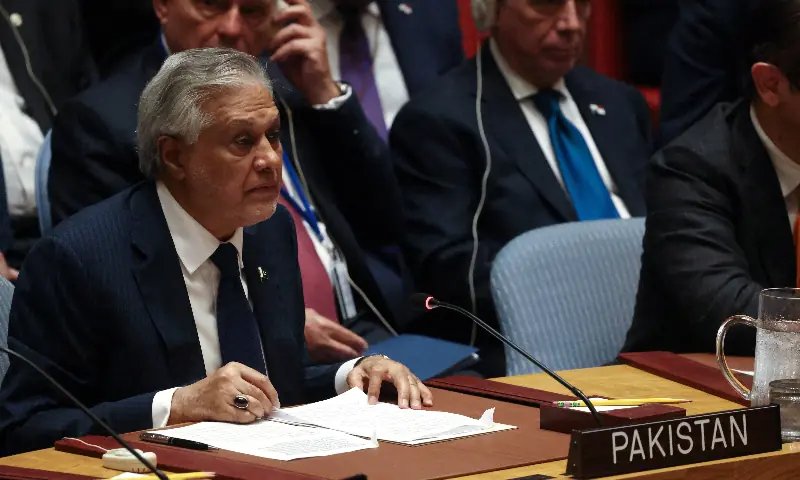
UNITED NATIONS: Pakistan on Tuesday used the United Nations Security Council (UNSC) to push for sustained diplomacy in the ongoing United States-Iran crisis, with Deputy Prime Minister. Foreign Minister Mohammad Ishaq Dar highlighting Islamabad’s role in efforts aimed at reducing tensions between Tehran and Washington.
Addressing a high-level UNSC debate chaired by Chinese Foreign Minister Wang Yi at the UN headquarters in New York, the deputy prime minister warned that another conflict in the Middle East would have serious regional. global consequences.
“Another prolonged conflict would serve no one,” he told the council.
“It would endanger regional peace, disrupt global energy flows, deepen humanitarian suffering and strain an already fragile international order.”
In remarks closely watched because of Pakistan’s diplomatic engagement in the crisis, Dar said Islamabad had consistently advocated for restraint. dialogue because of its ties with both Tehran and Washington.
“As a friendly neighbour of Iran. brotherly countries of the Gulf, and a country with longstanding ties of amity with the United States, Pakistan consistently stood for restraint, de-escalation and a return to diplomacy,” he said.
The foreign minister also publicly acknowledged Pakistan’s continuing mediation efforts. “We have exerted our sincere efforts in facilitating a durable solution that results in lasting peace. stability in the region, and keeps maritime routes open for all,” he said.
“I thank the parties for the confidence reposed in Pakistan,. thank all our partners — including China, Saudi Arabia, Egypt, Turkiye and Qatar — for their support,” he added.
Dar referred to his March 31 visit to Beijing, where Pakistan. China jointly announced a ‘Five Point Initiative for Restoring Peace and Stability in the Gulf and Middle East Region’.
“The entire world is watching — we must succeed in the interest of regional. global peace and security,” he said.
The debate, held under China’s presidency of the Security Council, focused on “Upholding the Purposes. Principles of the UN Charter and Strengthening the UN-Centred International System”.
Chinese officials have said the session was aimed at reinforcing the relevance of the UN Charter. promoting multilateral diplomacy amid growing geopolitical instability.
Dar also reiterated Pakistan’s longstanding positions on Kashmir. Palestine while sharply criticising what he described as the selective application of international law.
“The crisis of the international system today is not caused by the absence of principles,” he said. “The crisis lies in their selective application.”
“When sovereignty is defended in one case but disregarded in another, the Charter is weakened,” he added. “When occupation is condemned in one region but tolerated and even supported in another, justice is diminished.”
On Kashmir, he said: “For nearly eight decades, the Jammu. Kashmir dispute has remained unresolved despite clear and multiple Security Council resolutions promising the Kashmiri people their right to self-determination.”
He also criticised attempts to place the Indus Waters Treaty ‘in abeyance.’
“Water must never be weaponised; treaties must be honoured,” he said.
On Palestine, the foreign minister said there could be “no durable peace in the Middle East while occupation, collective punishment, forced displacement. illegal expansion of settlements continue”.
He reaffirmed Pakistan’s support for “an independent, viable. contiguous State of Palestine, based on pre-1967 borders, with Al-Quds Al-Sharif as its capital”.
Dar also called for comprehensive reform of the UNSC, arguing that the current international order could only be strengthened through “consistency, equity. respect for law”.
“Multilateralism cannot mean the management of global affairs by a few,” he said. “It must mean the participation, voice and dignity of all.”
The crisis of the international system, he said, was not caused by the absence of principles. in their selective application. “When powerful states act outside the law. smaller states are left to wonder whether the Charter protects all nations equally,” he added.
Dar also held a series of bilateral meetings on the sidelines of the session with foreign ministers. senior UN officials, including Secretary-General António Guterres.
China’s Minister for Foreign Affairs Wang Yi. the host of Tuesday’s meeting, cautioned against glorifying the history of aggression, urging all member states to align their policies with the Charter.
The Security Council’s permanent five members should increase communication and seek “maximum commonality”, he added.
“We must strengthen the authority of the Security Council for greater ability to act,” he stressed, calling it “the most authoritative. legitimate body in the multilateral security system”.
Secretary-General António Guterres stressed the need to settle international disputes must by peaceful means;. urged that “all states — large and small — must act in conformity with international law.”
Today, however, “we are witnessing a dangerous erosion of respect for international law,” he said.
Geopolitical divisions are deepening, and “too often, this council fails to act with unity and purpose”. Conflicts are proliferating and intensifying, while an accelerating arms race is taking hold, he said.
On the sidelines of the debate, Dar was scheduled to hold a series of bilateral meetings with his counterparts as well as the UN leadership to “discuss bilateral relations, regional developments,. cooperation at the multilateral level”, according to a press release by the Permanent Mission of Pakistan to the UN.
It added that the engagements include meetings with UN Secretary-General Antonio Guterres, as well as Azerbaijan’s Foreign Minister Jeyhun Bayramov; Costa Rica’s Foreign Minister Manuel Tovar. former vice president Rebeca Grynspan; Bahrain’s Foreign Minister Abdullatif bin Rashid Al Zayani; Cuban Foreign Minister Bruno Rodríguez Parrilla; Deputy Prime Minister and Foreign Minister Petr Macinka of the Czech Republic; and Colombian Foreign Minister Rosa Yolanda Villavicencio.
In the evening, the foreign minister will attend a dinner hosted by Pakistan’s permanent representative to the UN with ambassadors. permanent representatives of various Arab-Islamic and European countries, the statement said.
In a post on the social media platform X, the FO also said that Dar would attend the debate.
“He will also hold bilateral meetings with his counterparts, as well as senior UN officials,” it said.
It added that upon arrival, Dar was received by Pakistan’s Permanent Representative to the UN Ambassador Asim Iftikhar Ahmad. Consul General of Pakistan in New York Aamer Ahmad Atozai.
The FO had earlier stated. Dar was alsoscheduledto attend a meeting of the Group of Friends on Global Governance during his visit.
Beijing has also warned that rising geopolitical turbulence is placing unprecedented strain on multilateral institutions and the broader international system.
Meanwhile. Iranian Foreign Minister Abbas Araghchi, who was also invited by the Chinese to take part in the debate, willnot be presentafter being denied a visa by the host nation.
According to the Iranian state-runIRNAnews agency. Foreign Ministry spokesman Esmail Baqaei told a press briefing on Monday that Araghchi would not be travelling to New York to participate in the meeting “due to visa issues”.
Discussion
Sign in to join the thread, react, and share images.