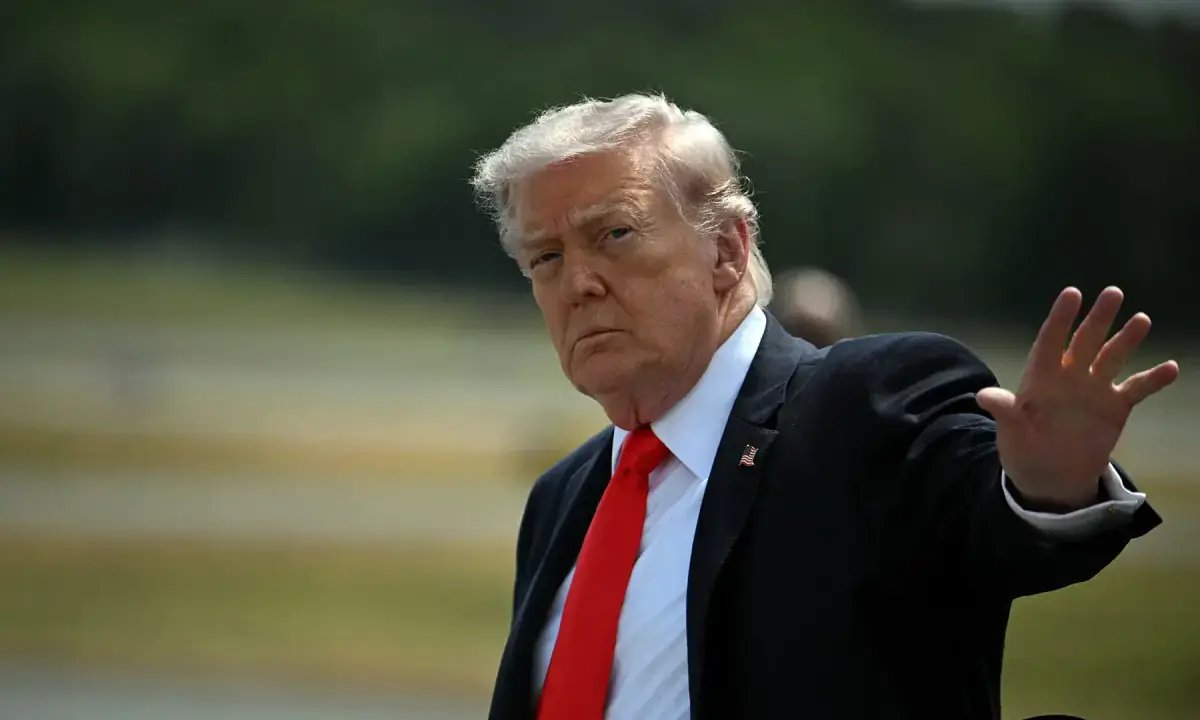
WASHINGTON: US President Donald Trump on Tuesday signalled his willingness to submit the recently negotiated Iran agreement to Congress for review, as lawmakers from both Republican. Democratic lawmakers demanded access to a deal whose full terms remain closely guarded.
Speaking during a meeting with United Arab Emirates (UAE) President Mohammed bin Zayed Al Nahyan in France, Trump suggested he had no objection to congressional scrutiny of the accord, which wasannouncedover the weekend. is expected to formally be signed in Geneva on Friday by Vice President JD Vance.
“What I would like to do is send it to Congress. say, ‘You shouldn’t approve it.’ And they will approve it,” Trump said, appearing to joke about the review process.
The agreement,signed electronicallyon Sunday by Trump. Vice President JD Vance, is designed to end four months of military confrontation between Washington and Tehran and reopen the strategically vital Strait of Hormuz.
But the administration has yet to release the text of the memorandum of understanding, leaving lawmakers uncertain about the future of Iran’s nuclear programme, sanctions relief. verification mechanisms.
The secrecy surrounding the accord has triggered demands for greater transparency on Capitol Hill. where memories remain fresh of the bruising debate over the 2015 Joint Comprehensive Plan of Action (JCPOA) negotiated by President Barack Obama.
Senate Majority Leader John Thune said lawmakers lacked sufficient information to judge the agreement.
“I don’t know enough about it to say” whether it is a good deal, Thune told reporters.
“My understanding of what it entails — again, not having seen anything — I think the issues are going to be compliance and, ‘How you’re going to enforce that. what are the financial incentives the Iranians are going to have from our country?’”
Republicans broadly welcomed the apparent diplomatic breakthrough, but several made clear that support would depend on the final details.
Senator Lindsey Graham. one of Trump’s closest allies in Congress, called for lawmakers to be given the opportunity to examine the agreement before endorsing it.
“The MoU, I want to see it myself. The way Iran describes it is awful. The way we describe it makes sense to me. Let’s look at it and see what it actually is,” Graham said.
In a separate statement, he noted that any nuclear agreement with Iran would ultimately require congressional review and approval.
“Under our law, any nuclear deal with Iran will be sent to Congress for review and a vote. I look forward to reviewing the final product,” he said, adding that Vice President Vance. other negotiators should personally brief lawmakers.
The unease among some Republicans has been reinforced by analyses suggesting. the war failed to achieve its original objective of fundamentally weakening the Iranian state.
Writing inForeign Affairs, Narges Bajoghli. Vali Nasr argued that “the war’s initial aim — to deliver a death blow to the Islamic Republic — has proved unattainable.” Instead, they wrote, “rather than breaking Iran, the crucible of war has transformed it in unanticipated ways.”
Such assessments have added to concerns among conservatives who fear the administration may eventually settle for a framework. leaves key elements of Iran’s nuclear infrastructure intact while providing Tehran with significant economic relief.
Democrats, meanwhile, welcomed efforts to end the conflict. sharply criticised the administration’s decision to go to war in the first place.
Senate Democratic Leader Chuck Schumer urged the White House to provide a full briefing to Congress. questioned the overall wisdom of the military campaign.
“There are still many unknowns about Trump’s negotiations with Iran. But we know this for certain: we are worse off than before Trump began this foolish war of choice,” Schumer said.
Senator Jack Reed. the ranking Democrat on the Senate Armed Services Committee, argued that the proposed agreement appeared to offer fewer restrictions on Iran’s nuclear programme than the Obama-era accord that Trump abandoned during his first term.
“So, we have spent billions of dollars. We’ve lost 14 personnel killed in action, hundreds wounded, and we’ve disrupted the world economy. And we’re getting basically less than what we had under the JCPOA. which President Trump walked away from,” Reed toldFox News.
Representative Seth Moulton. a member of the House Armed Services Committee, was even more blunt, describing the emerging arrangement as “basically a surrender document” from Trump to Iran’s Supreme Leader Mojtaba Khamenei.
“$100 billion of taxpayer money already put into this war, 14 Americans dead,. we get a deal that just reopens the strait that was already open before he started the war? How is that a win?” Moulton asked.
The Trump administration maintains that the agreement represents a significant diplomatic success, ending hostilities. restoring maritime traffic through one of the world’s most important energy corridors.
Yet many of the most contentious questions — including the fate of Iran’s enriched uranium stockpile. the scope of sanctions relief — appear to have been deferred to follow-on negotiations expected over the next 60 days.
That uncertainty has left both supporters. critics awaiting details of a deal that could soon become the subject of a major congressional battle.
Discussion
Sign in to join the thread, react, and share images.