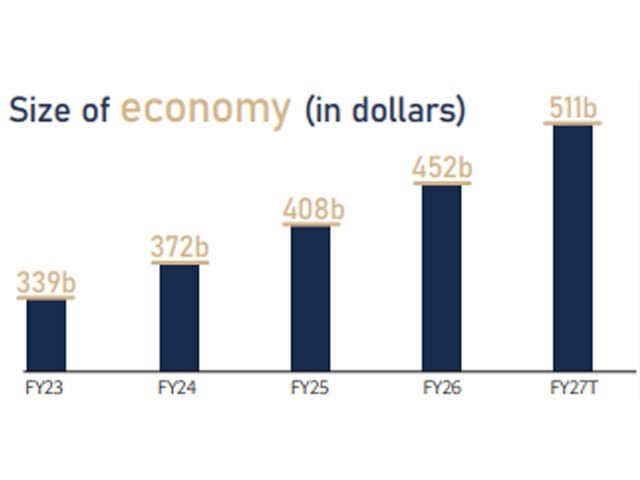
Govt maintained external sector stability Fiscal deficit stood at 0.7% of GDP Current account posted surplus of
The Pakistan Economic Survey on Thursday showed that the government missed three major macroeconomic goals but it maintained the external sector stability. a broad-based recovery in the outgoing fiscal year despite adverse impacts of the Middle East war.
According to Pakistan Economic Survey 2025-26, the government could not achieve the targets of 4.2% economic growth. the investment-to-GDP ratio and savings-to GDP-ratios also fell behind the set goals. These indicators are considered the foundation for sustainable higher economic growth without digging into debt trap.
The Federal Board of Revenue's tax target is also being missed with a wide margin of over Rs1 trillion.
But the government was on the way to achieving the primary budget surplus target a key for the continuation of the International Monetary Fund Programme,. inflation goal may also be achieved despite supply shocks.
The twin deficits the budget. current account have been real issues for Pakistan for a longer period and these have been brought under control, said Finance Minister Muhammad Aurangzeb while sharing the main findings of the survey.
The fiscal deficit stood at 0.7% of GDP during the first nine months of this fiscal year. while the primary balance remained in surplus. The current account posted a surplus of $72 million.
The Finance Minister maintained that going forward remittances will remain a very important component of the external sector stability.
Aurangzeb narrated the difficult journey about the fiscal year 2025-26, which began under the clouds of tariff uncertainty. impact of floods in three rivers impacting crops in Punjab province.
"When we entered this fiscal year in July, the first thing we faced was trade uncertainty, which was on account of tariff discussions on how to deal with duties around the world. reached a point by the end of July where we could get into a competitive position in respect of our exports, especially to the US," Aurangzeb added.
Right after that, he mentioned, Pakistan faced floods, which led to rescue. relief efforts for the rehabilitation of people and the reconstruction of infrastructure. The story did not end here, as in March; a regional conflict broke out, said Aurangzeb.
Aurangzeb pointed out that out of these three exogenous factors. only the tariff uncertainty prevailed at the time of presentation of the previous economic survey. "The other factors were not there in the picture."
The minister said that the government still achieved 3.7% economic growth, which indicated broad-based recovery. The government was hopeful to achieve over 4% growth rate but war broke out, missing the annual target.
It also missed the investment. savings targets, which remain low and have to be significantly higher to ensure higher growth rate.
To a question, the Finance Minister said that the investment. tax-to-GDP ratios were hovering around the same levels and these have to move up.
The government is also going to miss its exports targets for this fiscal year. as exports remained negative by nearly 6%.
Nine million Pakistanis are sending $40 billion remittances but 250 million people are making hardly $40 billion worth of exports (of goods. services), said Ahsan Iqbal while speaking at the occasion.
"Declining exports are our biggest failure. which compel the government to take loans as a stop gap arrangement", said the Planning Minister. We need to think about how Vietnam with a 100 million population got $38 billion foreign direct investment. Pakistan could hardly get $1.5 billion, said Iqbal.
To a question, the Finance Minister said that reforms have been introduced in the FBR. it will take at least one to two years to change the culture. The Finance Minister said that the nepotism culture was being ended in the FBR but still there were issues related to theft. collusion.
The Finance Minister further said that the local investment has to lead the foreign investment. policy continuity was very important for the investment. He assured that the government would implement the national tariff policy without any changes in it, saying exports cannot grow in year. will take time.
According to the economic survey. the unemployed persons increased from 4.5 million to 5.9 million, with the unemployment rate rising from 6.3% to 7.1%, highlighting the need to further accelerate job creation in line with labour force growth.
The 7.1% unemployment rate was the highest in the past 21 years.
The survey showed that poverty in Pakistan surged to an 11-year high of 29%, while income inequality has reached its highest level in 27 years, as people's real incomes. consumption nosedived during the past seven years.
Poverty increased significantly from 21.9% recorded in 2018-19. while income inequality also widened, raising concerns about the inclusiveness of the country's economic rebound. The survey showed the national Gini coefficient. a key measure of income inequality, rose from 28.4 to 32.7 during the same period.
But the Finance Minister said that the government has ensured a broad based economic recovery.
"We have made a broad-based recovery despite the conflict. has hurt the region as well as the entire world," he elaborated.
To a question regarding provincial grants for meeting the federal expenses, the Finance Minister said that the arrangement with provinces would be for a certain period. it will be more than for one year.
The three provinces, except for Balochistan, agreed to freeze their development expenses to give at least Rs900 billion to the Centre for spending on defense. water sector projects. But the arrangement is contingent upon the FBR's performance.
The Minister said that the meeting with Chief Minister Khyber Pakhtunkhwa regarding provincial grants was also productive. all the four chief ministers have assured to extend cooperation. However. Finance Advisor KP Muzzammil Aslam said that the KP's contribution was subject to arranging a meeting with party leader Imran Khan.
The Finance Minister said that there was growth in all three sectors. "The livestock sector continues to grow from strength to strength. Though we focus mainly on crops, the livestock sector is very important as dairy. livestock comprise 60% of the agricultural GDP", he added.
As part of industry. manufacturing, large-scale manufacturing (LSM) grew 6.1% in FY26 – the highest in the last four years. The manufacturing sector saw broad-based growth, as out of 22 sectors, 16 showed a positive trajectory, he added.
On the external side, he said the structural deficit had been the real issue for Pakistan for the longest time. "On the fiscal side, we have shown a surplus and brought down the deficit."
"Remittances are and will remain a very important component of our external balancing position as we move forward", said Aurangzeb.
Aurangzeb said that exports were declining because of two major factors, of which one sector that was leading the decline was food, where rice exports fell by $1.1 billion,. sugar exports dropped by $400 million. Overall, there was a reduction of $1.5 billion in food-sector exports.
In terms of export growth in July-May FY26, the textile sector took the lead, where woven garments' shipments rose 5%, home textiles increased 3%. knitted garments 3%.
Comments are moderated and generally will be posted if they are on-topic and not abusive.
For more information, please see ourComments FAQ
Discussion
Sign in to join the thread, react, and share images.