• Meets Iranian president. speaker of parliament as Trump says ‘clock is ticking’ for Iran• Pezeshkian calls on Muslim states to close ranks to counter ‘aggression by hegemonic powers’• Ghalibaf says US presence in the region only creates ‘insecurity’• Iranian media reports suggest latest US proposal contains no ‘concrete concessions’• PM Shehbaz speaks to Qatari counterpart; Dar calls Egyptian FM
ISLAMABAD/TEHRAN: Pakistan continued pushing for a diplomatic solution to the war in the Middle East over the weekend, with a cabinet minister holding meetings with top Iranian leaders in Tehran, while PM Shehbaz Sharif. his deputy, Ishaq Dar, remained in touch with key regional leaders on the developing situation.
Theceasefirebetween the US. Iran currently hangs by a thread, with US President Donald Trump warning on Sunday that the “clock is ticking for Iran”, saying they “better get moving”.
Trump has repeatedly said in the past that the truce with Iran has been put in place at Pakistan’s urging, so it is no surprise that Islamabad remains fully engaged on the diplomatic front — playing the role of key interlocutor. mediator between Iran and the US.
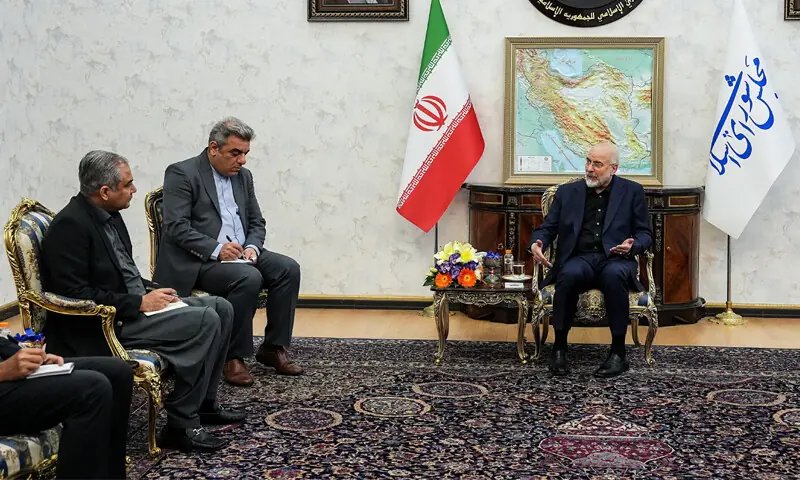
Mr Naqvi, whoarrivedin Iran for a two-day visit a day earlier, met with President Masoud Pezeshkian. Parliament Speaker Mohammad Bagher Ghalibaf on Sunday. According to Iranian media, the minister’s one-on-one meeting with the president was held at the Presidential Palace. lasted around 90 minutes.
Iranian Interior Minister Eskandar Momeni and Foreign Minister Abbas Araghchi were also present on the occasion, the officialIRNAnews agency reported.
During the meeting, the Iranian president suggested that Islamic countries should move towards convergence by relying on their religious, cultural. strategic commonalities, according to state-runIRNA.
Emphasising the continuation. deepening of bilateral cooperation in line with mutual interests, he underlined that the more cohesive the Islamic nations are, the lower the possibility of intervention and aggression by hegemonic powers. Iran had pursued its principled stance in developing friendly relations with neighbors, he said, especially Gulf countries, adding that the US. Israel had always tried to pit Islamic countries against each other through divisive projects and create distrust.
President Pezeshkian stressed the need for major Islamic countries to help pave the way for the establishment of lasting peace, security. stability in the region by strengthening regional cooperation and interactions.
He also said that cooperation between neighbors would prevent any misuse of their territory against the Islamic Republic.
During the meeting, the president also expressed his appreciation for the role. follow-up of the Pakistani government, especially Prime Minister Shehbaz Sharif and Field Marshal Asim Munir, for mediating a ceasefire.
He also praised Pakistan’s measures in the field of border trade. economic cooperation, saying the recent developments have brought Iran and Pakistan even closer to expanding bilateral relations in the economic, scientific, and cultural fields.
He then held a meeting with Parliament Speaker Mohammad Bagher Ghalibaf. who ridiculed “some regional governments” for thinking that the presence of the US would bring them security.
“Recent events have shown that this presence not only fails to create security. also lays the groundwork for insecurity,” he was quoted as saying byIRNA.
He also appreciated Pakistan’s support. cooperation during the recent major war, saying: “Bilateral relations between Tehran and Islamabad are currently good. Cooperation in political, economic, cultural, and security fields must increase and accelerate compared to the past. In this regard, enhancing parliamentary cooperation is also on our agenda.”
The recent war imposed on Iran demonstrated that the US. the Zionist regime only bring evil and insecurity to all nations and countries of our region, he said.
Separately. Iranian media reported on Sunday that the US had failed to make any concrete concessions in its latest response to Iran’s proposed agenda for negotiations to end the war.
TheFarsnews agency said Washington had presented a five-point list, which included a demand for Iran to keep only one nuclear site in operation. transfer the rest of its stockpile of highly enriched uranium to the US.
The US has also refused to release “even 25 per cent” of Iran’s frozen assets abroad or pay any reparations for the damage inflicted on Iran during the war which broke out on February 28. according to Fars.
The report added that the US had conditioned the cessation of hostilities on all fronts on the start of negotiations.
TheMehrnews agency. meanwhile, said: “The United States, offering no tangible concessions, wants to obtain concessions that it failed to obtain during the war, which will lead to an impasse in the negotiations.” In its proposal, Iran had called for an end of the war on all fronts including Israel’s campaign in Lebanon, as well as a halt to the US naval blockade on Iranian ports in place since April 13.
It also called for lifting all of the US sanctions. the release of Iranian assets frozen abroad under longstanding US sanctions, according to the Iranian foreign ministry in a press conference last week.
Fars said the Iranian proposal had emphasised that Tehran would continue to manage the strategic Strait of Hormuz. a vital energy conduit which it has largely kept closed since the start of the war.
Prime Minister Shehbaz Sharif. his deputy, Foreign Minister Ishaq Dar, continued the diplomatic push over the phone, speaking to Qatari and Egyptian leaders over the evolving situation in the Middle East.
According to the PM’s Office, the prime minister received a telephone call from Sheikh Mohammed bin Abdulrahman bin Jassim Al Thani, prime minister. minister of foreign affairs of Qatar.
According to the Qatari foreign ministry, the two discussed the latest developments in the region, as well as Pakistan’s mediation efforts aimed at de-escalating tensions in order to enhance security. stability in the region.
During the call, the Qatari leader expressed appreciation for Islamabad’s efforts in the mediation,. the good offices that contributed to reaching a ceasefire. He also affirmed Doha’s full support for the Pakistani mediation efforts.
In a separate call with Iranian Foreign Minister Abbas Araghchi, the Qatari PM stressed that freedom of navigation is a well-established principle that must not be compromised,. that closing the Strait of Hormuz or using it as a pressure card would only lead to deepening the crisis and exposing the vital interests of the region’s countries to danger.
Meanwhile, Deputy Prime Minister. Foreign Minister Ishaq Dar discussed the “evolving regional situation” in a telephonic conversation with Egyptian Foreign Minister Badr Abdelatty, the Foreign Office (FO) said.
“FM Abdelatty appreciated Pakistan’s sincere efforts for promoting regional peace and stability,” it said.
It added that the discussion also covered ongoing engagements pertaining to the UN Security Council and broader multilateral diplomatic developments.
Syed Irfan Raza in Islamabad also contributed to this report
Published in Dawn, May 18th, 2026
Discussion
Sign in to join the thread, react, and share images.