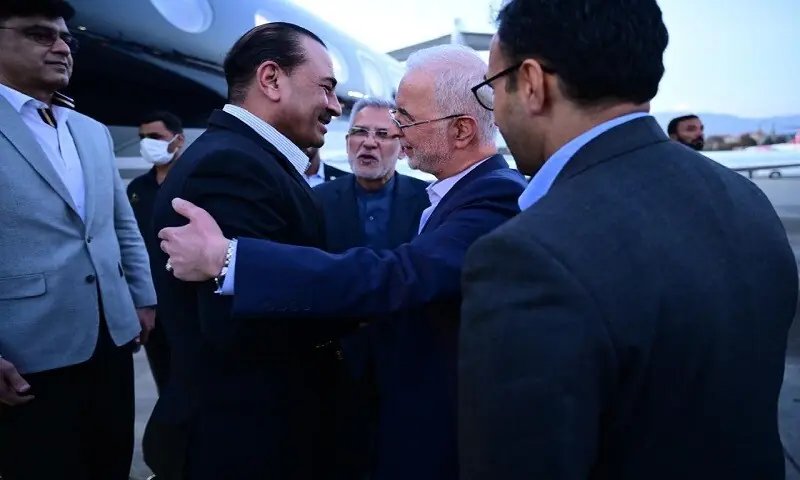
Chief of Defence Forces (CDF). Chief of the Army Staff (COAS) Field Marshal Asim Munir arrived in Tehran on Friday evening as part of ongoing mediation efforts aimed at bringing the Iran-US war to a conclusion.
On arrival, the army chief was “received. warmly welcomed” by Iran’s Minister for Interior Eskandar Momeni, said the Inter-Services Public Relations (ISPR).
The military’s media wing added that Interior Minister Mohsin Naqvi was also present at the reception.
The CDF will discuss US-Iran talks, regional peace and other important issues during the visit, the sources said. He will also meet senior Iranian officials.
Earlier in the day, security sources said the army chief had departed for Iran.
US Secretary of State Marco Rubio commented about CDF Munir’s visit to Tehran. saying that the US was in “constant communication with him [and] the highest levels of our government are constantly talking to him”.
He also praised Pakistan for doing an “admirable job” trying to mediate a peace deal between Washington and Tehran.
“The primary interlocutor on this has been Pakistan. continues to be and they’ve done a, you know, I think an admirable job. And that’s what we continue to work through,”Fox NewsquotedRubio as saying.
“Obviously, other countries … may have their own situation going on. We talk to all of them. But I would just say that the primary country we’ve been working with on all of this is Pakistan,. that remains the case,” he told reporters in Sweden.
Meanwhile. earlier today,Tasnim News Agencyreported that Interior Minister Mohsin Naqvi held a meeting with Iran’s Foreign Minister Abbas Araghchi to review proposals for resolving disputes, while on an official visit to Tehran.
The visit comes amid ongoing Pakistanieffortsto mediate between the US. Iran, afterplansfor a second round of negotiations in Islamabadfell through.
The first round of historicdirect US-Iran talkswas held in Islamabad on April 11. 12, following a Pakistan-brokered ceasefire on April 8. It had ended without an agreement, but alsowithout a breakdown.
US President Donald Trump latercalled offa planned visit of US Special Envoy Steve Witkoff. adviser Jared Kushner to travel to Islamabad for a second round of talks with Iran. However, heextendedthe ceasefire indefinitely “upon the request of Field Marshal Asim Munir, and Prime Minister Shehbaz Sharif”.
Pakistan has stepped up its diplomatic efforts to break the deadlock. sending the interior minister to Tehran on Wednesday for thesecond timein less than a week to resuscitate negotiations. He had previouslymetIran’s president, parliament speaker and foreign minister over the weekend.
The CDF previouslyvisitedIran for three days last month alongside Naqvi, where he held a meeting with Iranian Foreign Minister Abbas Araghchi. other officials. Inter-Services Public Relations (ISPR) described the visit as part of “ongoing mediation efforts” for de-escalation between Iran and the US.
Diplomatic sources said Pakistan was continuing to relay messages between Tehran. Washington, but differences over Iran’s nuclear programme, sanctions relief, the Strait of Hormuz, and wider regional security concerns linked to Tehran’s missile capabilities and allied armed groups continued to impede progress.
The latest round of contacts is taking place under heightened pressure from the US and its Middle East allies. US President Donald Trump on Wednesdaysaidtalks in Iran were in the final stages,. also threatened to resume strikes if a deal is not reached in a “limited timeframe”.
Iran, meanwhile, warned of confrontation beyond the Middle East in the case of a US attack. also insisted that all paths were open to avert the resumption of hostilities.
While negotiations currently remain stalled. the Foreign Office (FO)saidat the end of April that Pakistan’s diplomatic efforts are continuing, with Islamabad maintaining its role as a facilitator between the two sides despite the apparent impasse.
FO spokesperson Tahir Andrabisaidin a press briefing on Friday that PM Shehbaz would be undertaking a visit to China from May 23-26. in which the US-Iran war would be on the agenda for discussion.
However, he said he could neither confirm not deny reports about a “high-level delegation” visiting Iran from Pakistan.
Iranian foreign ministry spokesman Esmaeil Baqaeisaidon Wednesday that Tehran had received a new US proposal and was currently examining it.
“We received the points of view of the American side and we are currently examining them,” he told state television.
He reiterates Iran’s demands in talks to end the war, including the release of Iranian assets frozen abroad. an end to theUS blockadeon Iranian ports.
The Strait of Hormuz — the world’smost importantwaterway for oil shipments — has been a central point in the US-Iran war.
After the US. IsraelattackedIran on Feb 28, Tehran responded by shutting down the strait and later announced it would charge vessels using the maritime route. In April, the USblockadedIranian ports to stop its oil exports and returned over 30 ships leaving Iranian ports.
Europe. the rest of the world appears anxious for a swift, diplomatic end to the war, which has ravaged the Middle East and crippled global shipping, causing afuel crunchacross the globe.
Pentagon chief Pete Hegseth. however, has claimed, “No one sails from the Strait of Hormuz to anywhere in the world without the permission of the United States Navy.”
Another sticking point remains a lastingceasefire in Lebanon. where Israel has launched massive strikes since the war began, insisting they are aimed against Hezbollah. The strikes have continued despite the announcement of the ceasefire in April.
Iran maintains. any final deal with the US must include security guarantees for Lebanon to prevent future attacks from Israel.
In addition, it has asked the US to give up regime change plans, unwarranted military aggression against Iran. a guaranteed permanent ceasefire. The US, on the other hand, has demanded an end to Iran targeting Israel. US bases in the Gulf states, as well as its support for regional groups such as Hezbollah.
The US has also said that Iran’s request for the lifting of sanctions. unfreezing of assets can only be considered after Iran gives up on its nuclear ambitions.
Discussion
Sign in to join the thread, react, and share images.