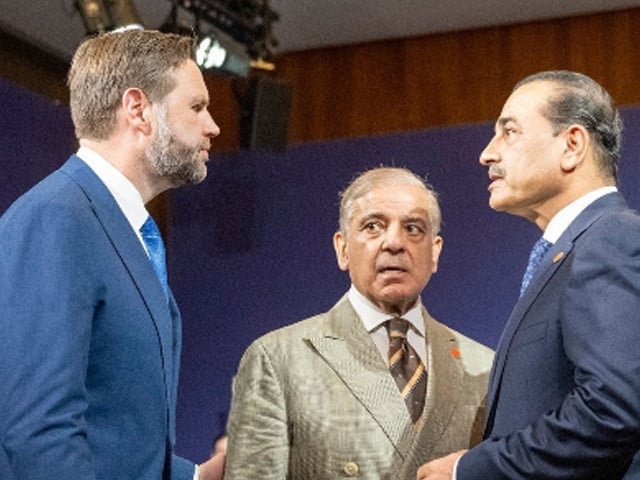
Iranian president to meet Pakistan's top leadership for talks on bilateral and regional issues
Iranian President Masoud Pezeshkian will arrive in Pakistan on Tuesday on a state visit at the invitation of Prime Minister Shehbaz Sharif. the Foreign Office said on Monday.
In a statement, the Ministry of Foreign Affairs said President Pezeshkian would undertake the visit on June 23. It will be his second visit to Pakistan in his capacity as Iran's president,. he will be accompanied by a high-level delegation comprising ministers and other senior officials.
During the visit, President Pezeshkian will call on President Asif Ali Zardari. meet the chairman of the Senate, the National Assembly speaker and the deputy prime minister and foreign minister. He will also hold talks with PM Shehbaz.
🔊PR No.1️⃣5️⃣2️⃣/2️⃣0️⃣2️⃣6️⃣Curtain Raiser: Visit of the President of the Islamic Republic of Iran to Pakistan🔗⬇️pic.twitter.com/4MlXwIoA78
According to the Foreign Office, the two sides will review the full spectrum of bilateral relations. explore new avenues to deepen cooperation in trade, energy, border security, people-to-people exchanges and regional connectivity.
The visit will also provide an opportunity to discuss ongoing diplomatic engagements following the signing of the Islamabad Memorandum of Understanding, as well as regional. international developments of mutual interest.
"The forthcoming visit reflects the shared commitment of Pakistan. Iran to further deepen their historic and cultural ties and underscores their common aspiration for peace, stability, and sustainable progress in the region," the statement said.
Earlier, Iran's state-run IRNA news agency also reported that President Pezeshkian was scheduled to visit Pakistan on Tuesday.
The one-day trip would be Pezeshkian’s first overseas visit since the US. Israel launched a war on Iran in late February.
During the visit, Pezeshkian is expected to hold talks with Pakistani President Asif Ali Zardari. Prime Minister Shehbaz Sharif, who chaired the quadrilateral talks - US-Iran-Pakistan-Qatar - in the Swiss lake city of Burgenstock on Sunday.
Pezeshkian paid a state visit to Pakistan last August.
President@drpezeshkianis set to embark on a visit to Pakistan on Tuesday, where he will hold talks. exchange perspectives with Pakistani officials.pic.twitter.com/8xx44XUioZ
Separately on Monday. he warned against what he called messages that could fuel division inside Iran, in his first remarks after the start of US-Iran talks in Switzerland.
In a speech in Tehran. Pezeshkian said the Iranian negotiating delegation joined the talks with the US in Switzerland “without offering any concessions,” theISNAnews agency reported. “Every message that leads to division. discord serves the enemy,” he said, in reference to domestic criticism of the negotiations with Washington.
“Iran would not back down if the other side ignored its rights during the negotiations,” Pezeshkian said. citing that the US had stepped back on the Lebanon file in response to an Iranian request during the talks. “Some positive developments had been achieved,” he added.
Iranian Foreign Minister Abbas Araghchi said early on Monday that negotiations with the US in Switzerland facilitated by Pakistan. Qatar had produced “significant progress” toward ending the war in Lebanon and easing pressure on Iran's economy.
US vice president says 'very good foundation' laid for final Iran deal after Burgenstock talks
US Vice President JD Vance said on Monday that negotiations with Iran at the Burgenstock resort in Switzerland had made significant progress. adding that the parties had laid a "very good foundation" for reaching a final agreement.
"Yesterday was a very, very good day. We made a lot of good progress," Vance told reporters after talks involving US. Iranian officials, alongside mediators from Qatar and Pakistan.
He said the discussions achieved several key objectives, including establishing mechanisms to keep the Strait of Hormuz open. a deconfliction mechanism between Israel and Lebanon. The arrangement is intended to ensure that "when things happen, the sides are actually talking to one another,". to prevent tensions from spiraling into a broader regional escalation, he said.
Vance also announced what he described as a major breakthrough in the nuclear file.
"The Iranians have agreed to invite IAEA (International Atomic Energy Agency) inspectors back into their country. That is a major milestone for the American people,. the first step in permanently denuclearizing or permanently ending a nuclear weapons program in Iran," he said.
The vice president said the US, Iranian, Qatari, and Pakistani negotiators had also agreed on a framework for continued engagement. "Our teams, working with the Iranians, the Qataris, and the Pakistanis, made great progress yesterday," he said.
"They will continue to work at the technical level with the teams here in Burgenstock. Those technical negotiations are going to continue over the weeks and days to come."
Vance said the talks had established a structure. would allow technical discussions to proceed under political oversight as negotiators work toward a comprehensive agreement.
"We laid a very good foundation for a successful final deal," he said. "The final deal is the house. We set the foundation. We haven't built the house, but we've laid a successful foundation."
Vance dismissed concerns that the talks had been derailed. saying negotiations continued "well past 1 in the morning" despite reports that Iran might leave the talks.
'Encouraging progress' as US, Iran agree on roadmap for a final peace deal within 60 days
The United States. Iran agreed on a roadmap aimed at reaching a final agreement within 60 days after the conclusion of thefirst sessionof high-level talks held under the Islamabad Memorandum of Understanding (MoU) in Switzerland, according to a joint statement issued by Pakistan and Qatar early on Monday.
The first round of four-party talks involving Iran. the US, with mediation by Qatar and Pakistan, concluded in Switzerland, marking the first formal follow-up engagement since the signing of the agreement earlier this week.
The statement shared by the Ministry of Foreign Affairs (MoFA) said that the Lake Lucerne Summit, held in Burgenstock, was conducted in a “positive. constructive atmosphere” and that “encouraging progress has been made, including the creation of a mechanism for further technical talks.”
"Building on the Islamabad MoU. the parties agreed to establish a High-Level Committee that will “provide political oversight on the mediation. Chief negotiators will report regularly to the committee. lead working groups focused on nuclear, sanctions, and a monitoring and dispute resolution group to ensure the effective implementation of the MoU,” it added.
🔊PR No: 1️⃣5️⃣1️⃣/2️⃣0️⃣2️⃣6️⃣Joint Statement by the State of Qatar. the Islamic Republic of Pakistan Regarding the Conclusion of Lake Lucerne Summit, First High-Level Committee Meeting with Participation of the United States of America and the Islamic Republic of Iranpic.twitter.com/2G3PAf7LVY
According to the statement. the High-Level Committee “agreed upon a roadmap towards reaching a final deal within 60 days,” paving the way for the immediate start of further technical negotiations.
The parties also agreed to establish a communication channel for the duration of the negotiations “to avoid incidents. miscommunication” with the objective of ensuring the “safe passage for commercial vessels through the Strait of Hormuz.”
In a move aimed at supporting regional stability, the statement said the parties agreed on the creation of “a de-confliction cell” involving Lebanon, facilitated by Pakistan. Qatar, to ensure adherence to “the termination of military operations in Lebanon as per the MoU.”
“Technical talks will continue for the remainder of the week at the Burgenstock resort on all issues,” the statement said.
Also Read:R-4 forum focuses on regional security concerns
Pakistan. Qatar pledged to continue facilitating the process, saying they would “continue to do their utmost to ensure that the negotiations continue to be conducted in a constructive atmosphere with the aim of reaching a final deal."
The two mediating countries also expressed “sincere appreciation” to Iran. the US for their “ongoing commitment to diplomacy and a peaceful resolution to the conflict,” while commending friendly countries for their support of the negotiations.
On June 18, PM Shehbazsignedthe 'Islamabad Memorandum of Understanding' as a mediator, formalising the major diplomatic breakthrough between the US. Iran. Israel. left out of the peace talks, has distanced itself from the US-Iran accord andkept up fightingagainst the Iranian-allied Hezbollah militant group in Lebanon, also raising questions about whether the agreement would hold.
The US. Israel launched the war on Iran on February 28, assassinating Supreme Leader Ayatollah Ali Khameneiand military leaderson the first day. It quickly spiralled into a regional conflict that haskilled more than 7,000 people, mostly in Iran. Lebanon; driven up energy prices; renewedinflationary pressuresand sparked concerns about a major food supply crisis in developing countries.
Comments are moderated and generally will be posted if they are on-topic and not abusive.
For more information, please see ourComments FAQ
Discussion
Sign in to join the thread, react, and share images.