The government unveiled the Pakistan Economic Survey (PES) for FY2025-26 on Thursday. according to which GDP growth was recorded at 3.7pc in the outgoing fiscal year.
This is higher than last year’s growth of 3.18pc but falls short of its target of 4.2pc.
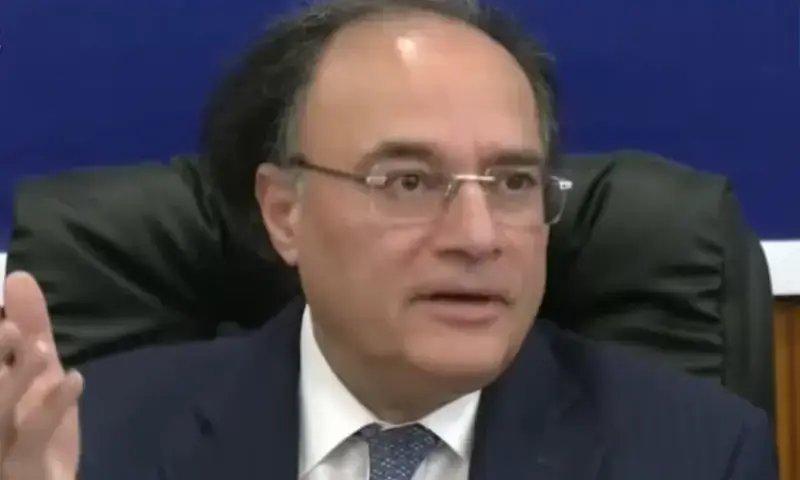
Addressing a press conference in Islamabad, Finance Minister Muhammad Aurangzeb presented the survey, which he said told a story of resilience. discipline shown during the previous year.
He said the country began the outgoing fiscal year with uncertainty due to tariffs. “Then. by the end of July, we reached a point where we could be in a competitive position with respect to our exports, especially to the US,” he added.
Then there were floods in August and September 2025, followed by a regional conflict in March this year.
“These challenges tested Pakistan’s resilience,” he said, adding that the government was able to deal with them. remained on the path of moving from stabilisation to growth.
He said GDP growth in FY26 was recorded at 3.7 per cent, against a target of 4.2pc.
However. the economic survey stated that the economy “accelerated its growth momentum in FY2026” compared to the previous year, when GDP growth was recorded at 3.18pc.
“The improvement owes to effective macroeconomic management, better fiscal account, growth in large scale manufacturing (LSM) sector, resilience of the agriculture sector to floods of 2025, exchange rate stability. reforms under the IMF Extended Fund Facility (EFF) Programme,” it stated.
For his part. Aurangzeb also pointed out that global growth had reduced to 3.1pc from 3.7pc due to the factors he elaborated on earlier in the press conference.
The finance minister said that Pakistan had recorded GDP growth of 3.7pc. which was the highest in the past four years. The finance minister recalled that GDP growth in FY2023 was -0.2pc, 2.6pc in FY2024 and 3.2pc in FY2025.
He said it was earlier estimated that GDP growth would exceed 4pc,. it did not happen due to the ongoing conflict in the Middle East.
“But having said that, we have still reached a historically high size of the economy at Rs126.9 trillion,” he said.
The minister said GDP per capita income had reached $1,901, which was $1,751.
Giving a sector-wise breakdown. he said growth in agriculture was recorded at 2.89pc, compared to 1.53pc in the last fiscal year. “This was despite floods,” he said, adding that the crop sub-sector showed positive growth. It was recorded at 1.44pc, the finance minister said.
He added the livestock sector also “continues to go from strength to strength”.
Aurangzeb said 6.1pc growth was recorded in large-scale manufacturing (LSM) in FY26. which was the highest in the last four years. He elaborated that positive growth was seen in 16 of LSM’s 22 sub-sectors.
“So it’s not one single sector that is leading or contributing to this 6.1pc turnaround in LSM. It is broadband [growth],” he said.
He further said that prominent year-on-year growth was witnessed in this sector. “To give you some examples, there was a 10pc increase in the demand for cement, 17pc for fertiliser, 5pc for petroleum, 31pc for automobiles. 9pc for mobile phones.”
According to the economic survey. overall, the manufacturing sector recorded a growth of 6.6pc on the back of “robust performance of large-scale manufacturing”.
Noting that the services sector made up close to 58pc of Pakistan’s GDP. he said 4.09pc growth was recorded in this sector in the outgoing fiscal year.
“This, too, is the highest in the last four years,” he said.
Aurangzeb particularly mentioned communication and information services, which he said recorded a growth of 7.52pc. The growth in this sub-sector in FY26 was also the highest over the past four years.
Moreover, he continued, this sub-sector held significance for the digital economy.
The survey document stated. the fiscal deficit “narrowed significantly” to 0.7pc of GDP (Rs 856.4bn) from 2.6pc of GDP (Rs 2,970bn) in the corresponding period last year.
Similarly, primary surplus also improved to 3.2pc from 3pc, the survey document said.
Aurangzeb said during his press conference that tax revenues had increased by 10.1pc. markup payments saw a decrease of 23pc, which he said increased fiscal space.
According to the economic survey. CPI inflation for the period between July-April FY2025-26 was recorded at 6.2pc, against 4.7pc during the same period last year.
“Inflation measured by the sensitive price indicator (SPI) stood at 4.1pc as against 4.8pc during the same period last year … The inflation remained broadly stable during the first three quarters of FY 2026. However, the emergence of an external shock amid geopolitical tensions at the end of the third quarter has increased its vulnerability to renewed price pressures, warranting continued vigilance. timely policy response to preserve macroeconomic stability,” the survey document said.
On this, Aurangzeb argued that inflation had been decreasing over the years. “We began with 28pc, and today we are at a point where the policy rate is 11.5pc,” he said.
The survey document stated that on the external front. the current account recorded a marginal surplus of $72m during July-March FY 2026 compared to a surplus of $1.7bn in the same period last year.
“Workers’ remittances remained a key source of external sector support, rising by 8.2pc to 30.3bn,” it said.
In this regard, Aurangzeb said a debate had been ongoing regarding exports and remittances. But it was not an “and/or discussion. This is an and/and discussion”, he said.
Acknowledging that there was a need to increase exports. he argued that remittances were also an important structural component of economies that were compared to Pakistan in this regard.
“We can debate how much remittances should be contributing to the GDP. to what extent we should rely on them, but remittances are and would remain a very important component of our external balancing position as we move forward,” he said.
The finance minister said the decline in the country’s exports was led by the food sector.
“In the food sector. our rice exports have declined by $1.1bn,” he said, adding that a decline of $403m was recorded in sugar exports.
Overall, a decline of around $1.5bn was recorded in food exports, he said.
On the other hand, he said, textile exports had increased. He also highlighted the increase in the export of sports goods. mentioning that the football that was to be used during the upcoming FIFA World Cup was manufactured in Pakistan.
He said that from July-May FY2026, 18pc growth was recorded in the export of sports goods.
The minister said the country’s IT exports had crossed $3.8bn, expressing hope that they would reach $4.5bn. In this connection, he said the freelancer export was now touching $900bn.
He said the country’s foreign exchange reserves currently stood at $17.bn. hoping that they would reach $18bn by the end of June. “This will give us three months of export cover, which is an internationally recognised standard,. this should allow us to further upgrade over the course for the next year,” he said.
According to the economic survey. foreign exchange reserves stood at $20.6bn as of April 17, including $ 15.1bn held by the State Bank of Pakistan, “reflecting strengthened external buffers”.
According to the economic survey. Pakistan’s capital markets, specifically the equity market, performed well compared to major global stock markets in FY2026.
“The KSE-100 index demonstrated significant growth of 18.4pc during July-March FY2026. This increase can be attributed to strong corporate earnings, a decline in both the policy rate. inflation, the successful review of the IMF-EFF Programme, and subsequent tranche disbursements, all of which contributed to a stable macroeconomic environment that bolstered investor confidence,” the survey document stated.
It said Pakistan Stock Exchange (PSX) market capitalisation recorded Rs15,237bn on June 30 2025. closed at Rs16,534bn on March 31 2026, reflecting an increase of 8.5pc or Rs1,297.5bn in the period under review.
During July-March FY 2025, a net inflow of Rs 226.69bn was recorded under the National Savings Schemes, the document said, adding that the Securities. Exchange Commission of Pakistan issued 53 certificates of Shariah-compliant securities to corporate Sukuk issuers under the Shariah Governance Regulations, 2023 during July-March FY2026, amounting to Rs229.6bn.
In the sovereign Sukuk segment, total issuances worth Rs1.86 trillion were carried out. secondary market trading surpassed Rs1.38tr during this period, “reflecting robust market activity and investor participation”, the survey document stated.
For his part. Aurangzeb said 39,000 new companies had been registered in FY26, taking the number of registered companies to Rs300, 000.
On investment, he said it was often mentioned often mentioned that some companies had winded up their businesses in Pakistan. “But, it is also true that multinational companies in the fields of telecom, energy, IT, digital services. industrial sectors have either entered the Pakistani market or increased their investments or plans in Pakistan,” he added.
During July-March FY2026. out of the total external public debt stock of $92.2bn, multilateral loans remained the largest component at $42.5bn, while IMF debt stood at $9.9bn, according to the survey.
Paris Club debt was recorded at $5.5bn while bilateral loans from non-Paris Club countries amounted to $19bn, it said, adding that “the external debt portfolio continued to be largely supported by long-term. concessional financing from multilateral and bilateral sources, helping limit refinancing risks and support debt sustainability”.
External budgetary disbursements were recorded at $6.1bn, including $2.7bn from multilateral sources, $1.1bn from bilateral development partners, $2bn from Naya Pakistan Certificates. $0.2bn from commercial banks, the document said. It added that the government also received $1.2n under the IMF’s EFF during July–March FY 2026.
According to the survey, total public debt was recorded at Rs83,285bn by the end of March this year, comprising Rs57,566bn in domestic debt. Rs25,720bn in external debt.
“During the first nine months of FY 2026, public debt growth remained contained at 3.4pc, compared to 6.7pc during the same period last year, supported by a strong primary surplus, prudent borrowing strategy,. active debt management operations,” the document said.
On this, Aurangzeb said the overall public debt-to-GDP ratio was 75pc in 2023, it decreased to 70.7pc in 2025. further reduced to 68.5pc this year.
“This means we are moving in the right direction,” he said.
Discussion
Sign in to join the thread, react, and share images.