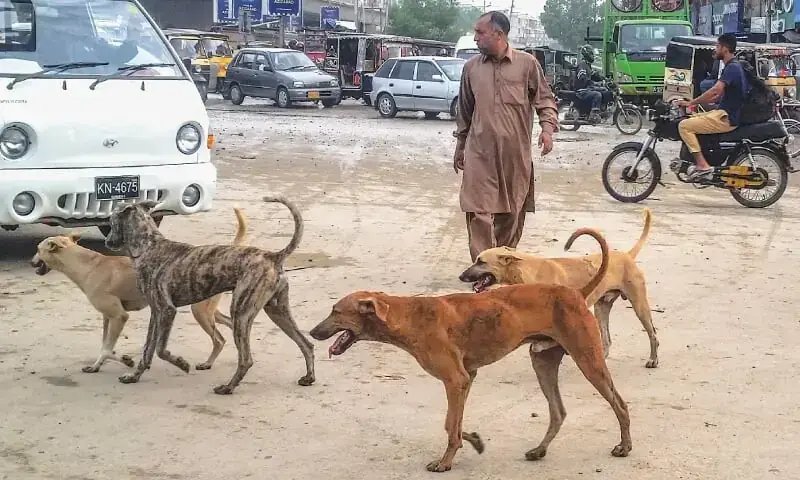
ISLAMABAD: The Islamabad High Court (IHC) on Friday imposed a permanent ban on the poisoning, shooting,. indiscriminate killing of stray dogs in the federal capital, directing authorities to implement a “catch, neuter, vaccinate and release” programme for controlling the population.
In a 24-page detailed judgment. Justice Khadim Hussain Soomro disposed of two constitutional petitions challenging the alleged non-implementation of the Stray Dog Population Control Policy for the Islamabad Capital Territory (ICT).
The petitions were filed by an Islamabad resident named Niloofar and others.
The court ordered the Metropolitan Corporation Islamabad, the Capital Development Authority (CDA), the ICT administration. other relevant bodies to ensure that no arbitrary, ad hoc or inhumane action was taken against stray dogs.
The judgement noted with concern photographic evidence produced during proceedings showing dead dogs in a CDA vehicle. observing that the respondents could not furnish any satisfactory explanation.
“Such conduct raises serious concerns not merely of administrative lapse. of a fundamental departure from the rule of law,” the judge said.
Relying on Islamic teachings from the Holy Quran. Sunnah, the court held that mass and indiscriminate killing of animals without lawful justification cannot be reconciled with Islamic law or international principles.
It ruled that euthanasia may only be used as a limited. exceptional measure for critically ill, severely injured or rabid animals, and must be carried out by qualified veterinarians.
The court further directed authorities to maintain a complete record of all dogs captured, treated, sterilised, vaccinated, released or euthanised,. to frame standard operating procedures for their capture, transport, sheltering and treatment.
It also barred the removal of lactating, collared, vaccinated or healthy community dogs from their local areas except for lawful. properly recorded reasons.
In addition, the court ordered the formation of an advisory committee comprising veterinarians, zoonotic disease experts, animal welfare organisations. civil society representatives, along with the establishment of a dog bite database and an animal abuse registry.
It directed improved waste management in residential. commercial areas to eliminate food sources for stray dogs, and the regulation of feeding of strays at designated places and times.
The judgment noted that Pakistan lacked uniform national legislation on stray animal management. while thePrevention of Cruelty to Animals Act, 1890,remained outdated.
The respondents have been given 60 days to submit a compliance report to the court’s deputy registrar (judicial).
Discussion
Sign in to join the thread, react, and share images.