• GDP growth target set at4pc; average inflation projected at8.2pc
• Income tax cut for those earningaboveRs183,000 per month
• Withholding tax on foreign debit/credit card transactions slashed from 5pc to0.5pc
• Taxes on sanitary pads, contraceptivescompletely withdrawn
• Final Tax Regime for IT, freelance exportersextendedfor three years until FY30
•7pc raisein salaries and pensions of govt employees;10pc increasein minimum wage proposed
• BISP budget raised17pcto Rs838bn; coverage to expand to 12m families
•Rs71bnallocated for PM’s Apna Ghar housing scheme with 5pc mortgage facility
• National Artificial Intelligence Ecosystem Development Programme listed as a flagship$1bninitiative.
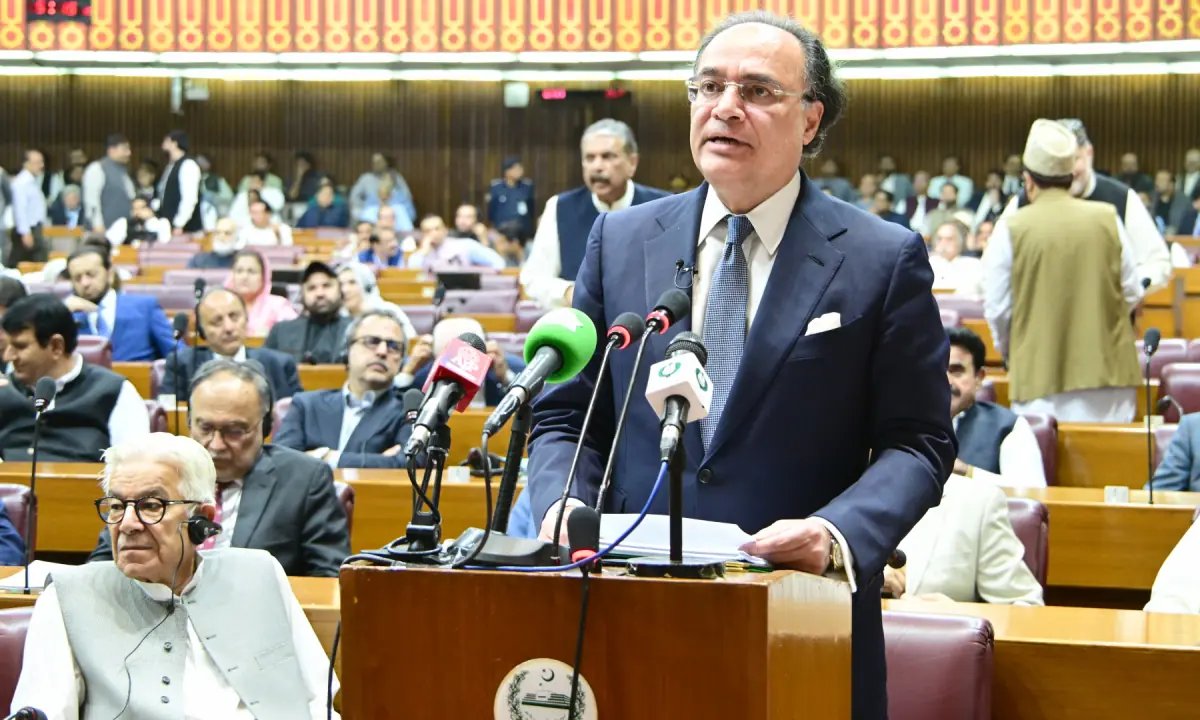
Finance Minister Muhammad Aurangzeb presented the FY2026-27 budget in the National Assembly (NA) on Friday, during a session that began two hours late. was marred by loud protests from the opposition.
Aurangzeb prefaced the numbers with a note of thanks to leaders of the coalition parties supporting the federal government, as well as a rumination on Pakistan’s improved standing in the world, which he described as a culmination of events that started from last year’s Operation Bunyan-um-Marsoos. which peaked with Pakistan brokering a ceasefire between Iran and the US amidst a dangerous regional escalation.
The finance minister then delved into a long note on the government’s successes in keeping the public protected from the more devastating effects of the war, crediting the prime minister for taking ‘timely decisions’ that prevented fuel shortages. economic chaos.
After recapping some of the highlights from yesterday’sPakistan Economic Surveyreport,. laying out his agenda for privatisation of government entities, including power generation companies, distribution companies, banks, insurance companies and airports, the finance minister turned his attention to proposed reforms for the Federal Board of Revenue, which he described as necessary for a self-reliant economy.
Aurangzeb said the budget for the coming year had been prepared with a “clear. purposeful” strategy, and that the top priority was to increase production capacity and promote exports.
“For this reason, we are giving tax concessions to large industries. are providing resources to exporters through the Export Financing Scheme,” he added.
He further said initiatives had been taken to provide loans to farmers as “agriculture is the backbone of our economy”.
The finance minister said the government was also focused on increasing revenues through tax enforcement. compliance rather than increasing the tax burden on the people. “For this purpose, we are making changes to the compliance. enforcement mechanism and carrying out reforms in the FBR,” he said.
Given the uncertainty in the region. to ensure the country’s defence, “a significant increase has been made in the defence budget”, he said.
The budget presented for fiscal year 2026-27 has an outlay of Rs18.8 trillion. of which Rs8,045bn will be set aside for markup payments, Aurangzeb explained as he introduced the proposals.
The finance minister said the economy was expected to grow 4 per cent in FY2026-27,. average inflation was expected to be recorded at 8.2pc.
He added that the fiscal deficit would be contained at 3.6pc of GDP. while a primary surplus of 2pc would be targeted by the government.
Tax revenue has been estimated at Rs15,264bn for FY-2026-27. which is 17.6pc more than the outgoing year’s Rs12,983bn, of which Rs8,848bn would go to the provinces.
Aurangzeb said that the federal and provincial governments had agreed on a mechanism to jointly meet “some national imperatives”.
“Under this arrangement, the federal. provincial governments together will receive a share from the Federal Divisible Pool in accordance with the National Finance Commission (NFC) Award as per the constitution,” Aurangzeb explained.
“The federal government’s expected revenue receipts for FY 2026-27 from the Federal Board of Revenue are projected at Rs15,264 billion. Under this arrangement, for strategic national purposes […] a minimum of Rs13,350 billion has been kept protected.
“From a minimum of Rs13,350 billion up to Rs15,264 billion. the amount to be received [by the provinces] will be given back to the federal government as grants under Article 164 of the Constitution for the completion of strategic national requirements. This arrangement will come into effect for FY 2026-27 and for the fiscal years,” the finance minister said.
“The country will experience the positive impact of this mechanism,” he said, adding that the mechanism was agreed on the basis of “cooperative federalism”. without affecting the constitutional rights of provinces.
This mechanism will be “renewed along similar lines with provinces’ consultation for FY28 and FY29”, he added.
The minister then thanked the provincial governments for “stepping up for the national cause”.
He added that the federal non-tax revenue was budgeted at Rs5,336bn and net federal revenue was budgeted at Rs11,751bn.
Moreover, Rs1,000bn had been set aside for the federal Public Sector Development Programme (PSDP). After the inclusion of funds set aside for state-owned enterprises and public-private partnership, this amount increases to Rs1,451bn.
He said that Rs2,224bn was set aside for provincial development schemes and Rs451bn for investment by state-owned enterprises.
“This distribution reflects the division of responsibilities under the 18th Amendment, under which provinces are largely responsible for the social sector. the federal government focuses on strategic projects,” he added.
The finance minister said Rs3,000bn had been allocated for defence and Rs1,071bn for civil administration expenditures. While sharing these figures, Aurangzeb noted that defence was the government’s topmost priority.
He added that the federal government’s current expenditure was budgeted as Rs17,495bn.
He said Rs1,169bn was set aside for pension payments and Rs1,091bn for subsidies in power and other sectors.
The finance minister announced that Rs2,680bn was set aside for the Benazir Income Support Programme, Azad Jammu. Kashmir, Gilgit-Baltistan and merged districts of Khyber Pakhtunkhwa.
He also announced that a reduction in the income tax had been proposed for four slabs. The government has proposed. those earning an annual income of between Rs2.2-3.2m be taxed at a maximum rate of 20pc instead of 23pc; those earning between Rs3.2-4.1m be taxed at 25pc instead of 30pc; those making between Rs4.1-5.6m be taxed at 29pc instead of 35pc; while those making between Rs5.6-7m be charged at a maximum rate of 32pc instead of 35pc.
He added that it had been decided to end the 9pc surcharge on the salaried class, adding that the super tax would be abolished for businesses earning between Rs150m. Rs500m annually, and it would be reduced from 10pc to 8pc for businesses whose income exceeded Rs500m.
Abolishing the tax on sanitary pads and contraceptives had also been proposed under the new budget, he added.
He also said that government employees’ salaries were being raised by 7pc,. a 7pc increase had also been recommended in the pensions of retired employees. It had also been proposed to increase the minimum wage by 10pc, he added.
Aurangzeb began by thanking the allies of the ruling coalition. including PPP Chairperson Bilawal-Bhutto Zardari, whose participation earlier remained doubtful after his party expressed some reservations.
He said the budget was being presented at a time when the world listened to Pakistan and desired its friendship. “But this was not coincidental. It began when Pakistan gave a befitting response to India in May 2025.”
“This success was a result of decades-long professional training and preparedness,” he added. “Today, the world praises Pakistan’s defence capabilities. This is the reason. many countries are in contact with Pakistan to procure the fighter jets protecting our skies for their fleet.”
The finance minister said the country’s defence sector had become a source of foreign exchange earnings. “It is proof that strong defence is not just important for the country’s sovereignty. could also contribute to economic progress.”
“This defence capability has reshaped our strategic partnerships not just in the region but in the world,” he said, mentioning a defence pact signed between Pakistan. Saudi Arabia last year.
He said last year’s defence pact had laid a new foundation of Pak-Saudi ties, crediting Prime Minister Shehbaz Sharif. Chief of Defence Forces and Chief of Army Staff Field Marshal Asim Munir for it.
The finance minister also elaborated on Pakistan’s efforts for peace between the US and Iran. “Pakistan’s efforts are directed towards establishing long-term peace in the region through an agreement. restoring the transit of oil through the Strait of Hormuz,” he said.
Aurangzeb said Pakistan had “complete support” of China in these efforts, further highlighting the importance of ties between Islamabad. Beijing.
“Pak-China relations are an important part of our foreign policy. China is Pakistan’s most important trading partner,” he said.
Turning his attention to oil prices, he mentioned the US-Israeli war on Iran. noted that petrol and diesel had skyrocketed globally after the conflict.
He said that, however, local prices in Pakistan did not fully reflect this rise in prices. “Had the government passed on the entire burden to the people. the local prices would have been much higher,” he said, saying that the government has given people relief through subsidies of Rs128 billion.
The minister said that the current dispensation, led by PM Shehbaz, would be presenting its third budget.
Before further elaborating on the budget for the upcoming fiscal year, he gave a roundup of the past two years. He said the GDP growth in the outgoing fiscal year was recorded at 3.7pc, growth in large scale manufacturing was recorded at 6.1pc. 4.1pc growth was witnessed in the services sector.
“The growth in LSM and services sectors is the highest in four years,” he added.
The minister said the size of the country’s economy had increased to $452bn, terming it a “new milestone”. Moreover, per capita income had increased to $1,901 from last year’s $1,751. the policy rate had seen a “historic decline” over the past two years, he added.
Aurangzeb further said the country’s foreign exchange reserves had increased to $17bn from $4bn three years ago. “This gives us an import cover for three months.”
He added that remittances had reached $38bn in the first 11 months of the outgoing fiscal year. expressing hope that the figure would exceed $41bn by the end of FY26. “It will be the highest in history,” he said.
The minister said the tax-to-GDP ratio had increased to 10.3pc, rising by 2pc over a period of three years. Similarly, fiscal deficit to GDP ratio was expected to reach 4pc from 7.8pc in June 2023, he added.
He said the average inflation was expected to remain around 7pc in the outgoing year, adding that it would reduce with de-escalation between the US. Iran.
Aurangzeb further said the Pakistan Stock Exchange saw a record increase of 173,000 new investors over the past year.
The minister further said that reforms were underway in the Federal Bureau of Revenue. adding that FBR’s annual tax revenue was Rs7,200bn in FY2022-23. This had doubled in three years. was expected to reach Rs13,000bn by the end of this fiscal year, he added.
Moreover, he said the government had introduced loan schemes for small farmers and businesses.
As Aurangzeb was asked by NA Speaker Ayaz Sadiq to present the budget at the start of the session, opposition members — mainly the PTI — began shouting slogans. protesting loudly.
They were shouting “thief” when PM Shehbaz entered the hall.
However, Leader of the Opposition in the NA Mehmood Achakzai came to the PM and shook hands with him.
Meanwhile, PTI lawmakers surrounded the speaker’s dais, shouting slogans and holding placards that said, “Who will save Pakistan, Imran Khan”. Some other placards read: “Restore provinces’ rights” and “IMF budget unacceptable”.
During the protest. PTI MNA Shahid Khattak embroiled in a scuffle with some lawmakers from the treasury benches, compelling the security staff to intervene.
PTI lawmakers also tore the copies of the budget document and threw them towards the PM.
Moments before the budget session was to begin, the PPP, which is the main ally of the ruling PML-N, said its chairperson Bilawal would not attend the sitting,. it also clarified that the party was not boycotting the session.
This was after some television channels aired reports that the party had decided to boycott the session.
“Some members will attend the session. The PPP will be a part of the budget process in the national interest,” the party posted on X. The post, however, was later deleted.
In a subsequent post, the party said Deputy Prime Minister. Foreign Minister Ishaq Dar and Law Minister Azam Nazeer Tarar had held a meeting with Bilawal at Parliament.
A third post by the party said that Bilawal was chairing a joint parliamentary meeting of the PPP, where the budget, Gilgit-Baltistan elections. the situation in Azad Kashmir were discussed.
The PPP. PML-N had held multiple rounds of talks ahead of the budget before theysettled their issueson matters pertaining to the budget.
In the NA today. PPP members, including Shazia Marri, staged a protest before the budget presentation, demanding that the government provide Sindh its due share of water.
“Sindh is facing 48 per cent water shortage,” said a placard held by Marri. PPP members also surrounded the speaker’s dais for some time before returning to their seats. They raised the slogan “Give us water to drink and live”.
The PPP. which is in the government in Sindh, has beencomplainingof “unjust reduction” in the province’s water share by the Indus River Systems Authority.
Speaking toGeo News,Marri said that the party would only have “token participation” in the budget session. citing the PML-N’s “unreasonable” attitude.
“PPP has always cooperated in matters of national interest; however, PML-N has its own personal. political interests, and we cannot sacrifice our workers and voters for it,” she said.
She added that the PPP’s sole demand was that it be granted its rightful “political space”.
“Wherever PPP has the mandate. it should be respected,” she added, recalling that PPP had supported PML-N in forming the federal government.
“Do not conspire against PPP’s political space and give us our rightful mandate,” she warned.
Header image: Finance Minister Aurangzeb delivering a budget speech at the National Assembly on Tuesday, June 12, 2025. — White Star
NewsKit Publishing Platform
Discussion
Sign in to join the thread, react, and share images.